Binaural beats: how they work and what the research actually says
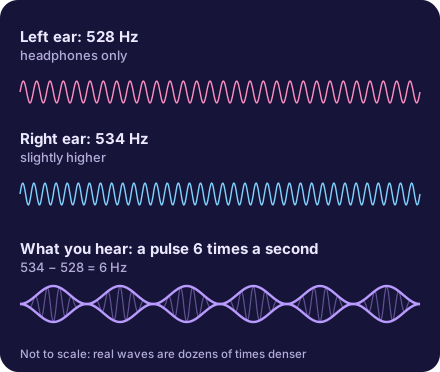
Binaural beats are two pure tones with slightly different frequencies, one in each ear: say, 528 Hz on the left and 534 Hz on the right. They never meet in the air, but your brain hears a slow pulse between them at the difference, here 6 times a second. It only works with headphones.
How useful that is remains an open question. A 2019 meta-analysis found a moderate effect on memory, attention, anxiety and pain perception. A 2023 review that tested the main promise, that the beats tune your brain waves, found a mixed picture: of 14 studies, 5 supported it and 8 contradicted it.
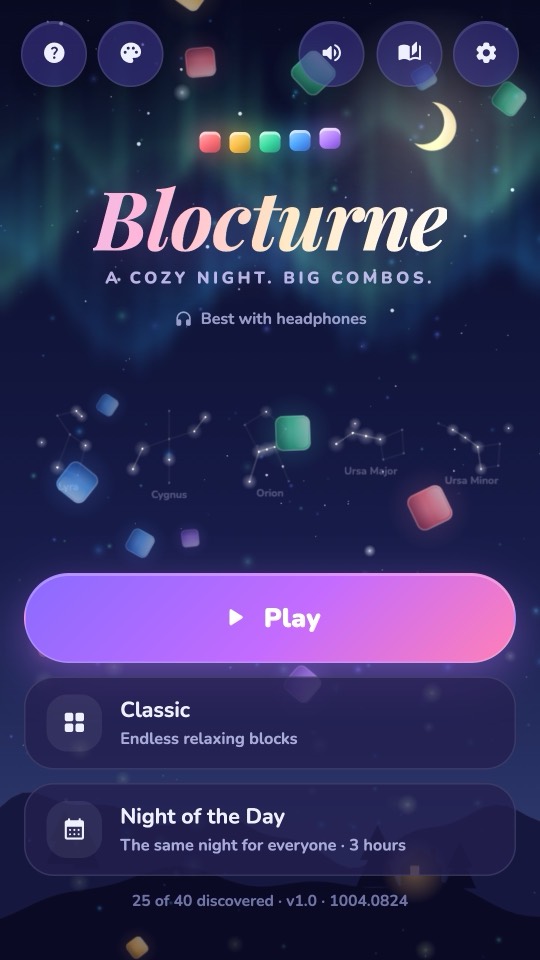
My game Blocturne has a "Binaural beats" slider, and I want players to know what it is without any marketing promises. So here's everything I learned while building it.
How it works
Play two close notes on one instrument and you'll hear beating: the sound seems to wobble, getting louder and quieter. That's plain physics, the waves adding up and canceling out. Binaural beats are different. Each ear gets its own pure tone, there's nowhere in the air for them to combine, and the pulse is put together by the brain itself, in the brainstem, where the signals from both ears meet.
The effect was described by the Prussian physicist Heinrich Wilhelm Dove in 1839 and made widely known by Gerald Oster's 1973 article in Scientific American.
A few practical things follow from this:
- you need headphones: from speakers, both tones reach both ears and mix in the air, so you get ordinary beating instead of binaural beats;
- the tones have to be fairly low: above 1,000 to 1,500 Hz the pulse is barely audible;
- the difference between the tones is small, from a fraction of a hertz to a few dozen.
Where brain waves come in
The brain's electrical activity is loosely divided into bands: delta (up to 4 Hz) is linked to deep sleep, theta (4 to 8 Hz) to drowsiness and meditation, alpha (8 to 12 Hz) to relaxed wakefulness, beta (13 to 30 Hz) to active thinking, and gamma is anything above 30 Hz. The idea behind binaural beats is that the brain follows the pulse: listen to 6 Hz and you get more theta activity. This is called entrainment.
It sounds logical, but it's exactly the part that's hardest to prove.
What the research found
The 2019 meta-analysis. Miguel Garcia-Argibay and colleagues pooled published experiments on how binaural beats affect memory, attention, anxiety and pain perception. The analysis covered 35 effect sizes, and the overall effect came out medium and consistent (g = 0.45). Two findings are useful in practice: masking the beats with white or pink noise isn't necessary, and listening before a task (or before and during it) worked better than listening only during it. (Psychological Research, 2019)
The 2023 systematic review. Ruth Maria Ingendoh, Ella Posny and Angela Heine tested the entrainment hypothesis itself: they gathered 14 studies that measured brain activity during listening. Five supported the hypothesis, eight contradicted it, and one had mixed results. The authors write that the question isn't settled yet: the studies are set up too differently to compare directly. (PLOS ONE, 2023)
How do these fit together? Experiments do show a moderate effect on how people feel and focus, but the mechanism, that it's really about brain waves falling into step, isn't proven. Maybe plain relaxation and expectation do the work: you put on headphones, listen to a steady sound and calm down. That's my own guess, not a research finding.
What plays in Blocturne
In the game, the beats play quietly under the music and have their own slider in the settings:
- theta at 6 Hz: 528 Hz left, 534 Hz right, the main layer;
- delta at 2 Hz (132 and 134 Hz) and 0.5 Hz (66 and 66.5 Hz), low, under the main layer;
- gamma at 40 Hz (528 and 568 Hz), which swells in for about twenty seconds every couple of minutes and fades out.
Each tone's volume slowly "breathes", rising and falling by 30% over 20 to 50 seconds, so the sound never turns into a nagging whine. The carrier tones are all C notes: the game's music is tuned to A = 444 Hz, which puts C at 528 Hz, so the beats are always in the same key as the pieces.
The slider starts in the middle, and if you move it to zero, there are no beats at all. Without headphones they do nothing, so for the first few launches the game suggests putting headphones on. I won't promise the beats will help you focus or fall asleep: in the game they're part of the sound, and everyone sets them to taste.
Is it safe?
I haven't found reports of harm at normal volume. A couple of common-sense rules: don't listen while driving or anywhere you can't afford to doze off, and don't turn it up, since the pulse comes from the difference between your ears, not from loudness. Makers of these recordings usually advise people with epilepsy to check with a doctor first, and that's sensible advice.
FAQ
Do you need headphones for binaural beats?
Yes. Each ear has to hear only its own tone. From speakers, the sounds mix in the air and there's no binaural effect.
Do binaural beats work?
Experiments have found a moderate effect on attention, memory and anxiety: the 2019 meta-analysis rated it as medium (g = 0.45). That the beats actually tune your brain waves isn't proven: in the 2023 review, 5 of 14 studies supported it.
Which frequency is best for studying or sleep?
There's no ready recipe. Theta (4 to 8 Hz) is usually linked to relaxation, delta (up to 4 Hz) to sleep, beta and gamma to active work, but the evidence for these links is weak.
How are binaural beats different from isochronic tones?
An isochronic tone is a single sound switching on and off quickly. It doesn't need headphones, but there's also noticeably less research on it.
Can you listen to binaural beats with music?
Yes, that's how most people listen to them: the tones play quietly under the music. In the 2019 meta-analysis, masking with noise didn't change the effect, so silence around the beats doesn't seem to be required.
Blocturne is a cozy night-time block puzzle: an 8×8 board, big combos and night pieces by Chopin, Satie and Debussy. Free to play, right inside Telegram.
Play in Telegram